


























Objective Questions – Metals and Alloys
Pick out the most appropriate option:
Answers are marked bold ;
1. Mild steel is an alloy of iron and carbon with percentage of carbon ranging from
(a) up to 0.2% (b) 0.15–0.3
(c) 0.3–0.5 (d) above 0.5.
2....
Alloys of Nickel
ALLOYS OF NICKEL
(i) German silver. It is a cupro nickel to which zinc has been added. A typical composition is 60% copper, 30% nickel and 10% zinc. Addition of zinc brings down the cost....
Non Ferrous Metals and Alloys
Non Ferrous Metals and Alloys - Properties and Uses :
Non-ferrous metals and alloys do not contain any significant quantity of iron. The most common non ferrous metals used in engineering applications are copper, aluminium,...
Bronze and its types
Bronze ;
Bronze is an alloy of copper and tin however commercial bronzes may contain other elements besides tin. In fact, alloys of copper with aluminium, silicon and beryllium, which may contain no tin are...
Advantages of NC/CNC Machines
CNC Machines have these advantages :
High Repeatability and Precision e.g. Aircraft parts.
Volume of production in CNC is very high
Complex contours/surfaces need to be machined. E.g.
Turbines
Flexibility in job change, automatic tool...
Diff B/w NC and CNC M/c
NC - Numeric Controlled and CNC - Computer Numeric Controlled Machines differ in these ways :
The difference between NC and CNC is one of age and
capability. NC is older compared to CNC
The...
Engineering Drawing
What is Engineering Drawing ?
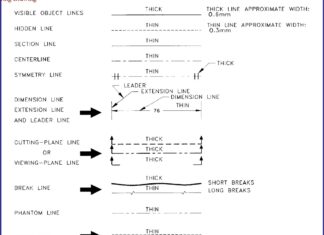
Engineering Drawing is a language to express details of any particular machine part, tool, process of working or assembling and others. Various symbols are used in E.D. to represent factors...
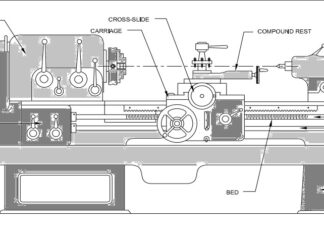
Lathe Machine Parts
The main parts of a Lathe Machine are :
- Headstock
- Tailstock
- Carriage
- Cross-slide
- Compound slide
- Bed
- Quick change gearbox
- Legs
- Feed shaft
- Lead screw
The following figure shows the parts of lathe in details ;
Specifications...
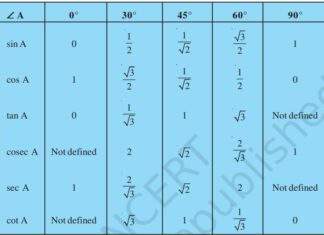
Trignometric Ratios
These are most commonly used trigonometric ratios ;
Also, these relations need to be remembered,
sin (90° – A) = cos A, cos (90° – A) = sin A,
tan (90° – A) = cot...
MOST COMMENTED

Territorial Army GK Questions
Territorial Army Commission PIB Questions asked on 25 Sep 2022.
Q1. Which among the following is an OTT based platform?
A) Twitter
B) Hotstar
C ) Facebook
D )...